Comprehensive analysis of India’s Special Intensive Revision (SIR) of electoral rolls covering 51 crore voters. Examines verification process, timeline, political implications, and voter impact.
Executive Summary: India’s Massive Voter Verification Exercise
The Special Intensive Revision (SIR) of electoral rolls represents one of the most extensive voter verification initiatives in democratic history, encompassing 51 crore electors across 12 states and union territories. Phase-II of this politically significant exercise commenced on November 4, 2025, with over 5.3 lakh Booth Level Officers (BLOs) undertaking door-to-door verification until December 4, 2025. This comprehensive revision occurs amid preparations for crucial 2026 state assembly elections in Tamil Nadu, West Bengal, and Kerala, generating both support and controversy regarding its implementation and potential impact on voter inclusion, particularly among marginalized communities. The SIR process marks a fundamental shift from previous revisions by transferring greater responsibility to voters for establishing eligibility, raising critical questions about balancing electoral integrity with accessibility in the world’s largest democracy.
The Election Commission of India commenced Phase-II of the Special Intensive Revision across nine states covering nearly 51 crore electors
1 Understanding the Special Intensive Revision (SIR) Process
1.1 SIR Framework and Implementation Timeline
The Special Intensive Revision constitutes a systematic overhaul of India’s electoral database, employing rigorous verification protocols that distinguish it from routine electoral updates. The Election Commission of India has established a meticulously structured timeline. The enumeration phase, active from November 4 to December 4, 2025, involves comprehensive household data collection. This preliminary stage will be followed by draft roll publication on December 9, 2025, with a claims and objections window extending from December 9, 2025, to January 8, 2026. The final electoral rolls will be published on February 7, 2026, establishing the voter foundation for upcoming state elections.
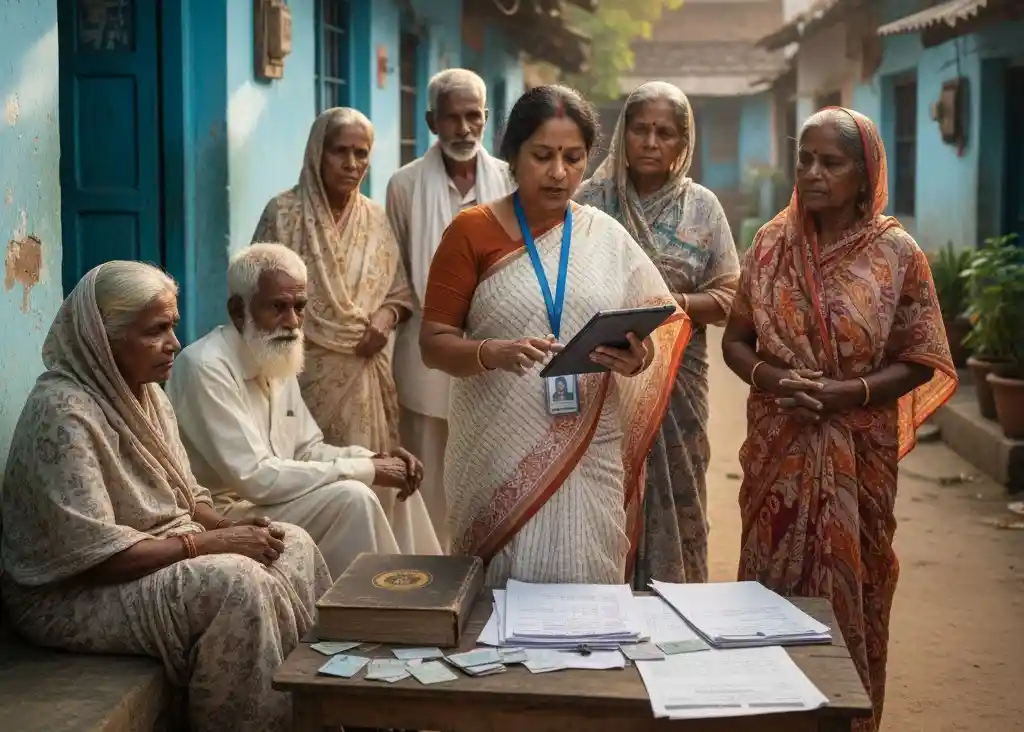
The administrative architecture relies heavily on Booth Level Officers (BLOs), who carry official identity cards with QR codes for verification and may be accompanied by Booth Level Agents (BLAs) nominated by political parties to ensure transparency. These officers are mandated to make up to three visitation attempts for absent residents, demonstrating the Commission’s effort to maximize participation while maintaining procedural rigor.
1.2 Documentation Requirements and Verification Protocols
The SIR process introduces specific documentation requirements that have generated significant public discussion. While initial enumeration requires only basic information, voters must reference the 2002 electoral roll and may later need to provide proof of citizenship from a list of specified documents . Acceptable documentation includes birth certificates, matriculation records, government employment IDs, passports, and property papers .
Table: SIR 2025 Key Implementation Timeline
| Process Phase | Start Date | End Date | Key Activities |
|---|---|---|---|
| Enumeration | November 4, 2025 | December 4, 2025 | BLO door-to-door visits, form distribution and collection |
| Draft Roll Publication | December 9, 2025 | – | Initial electoral lists made public for verification |
| Claims & Objections | December 9, 2025 | January 8, 2026 | Voters can correct errors, file inclusion requests |
| Hearings & Verification | – | January 31, 2026 | EROs review disputed cases and documentation |
| Final Roll Publication | February 7, 2026 | – | Official electoral rolls published for upcoming elections |
Critically, the Election Commission has clarified that the Aadhaar card functions primarily as identity proof rather than citizenship confirmation, creating potential complications for voters relying exclusively on this ubiquitous identification document. The documentation emphasis has raised concerns about potential barriers for women, elderly citizens, and economically marginalized groups who may lack formal documentation despite being legitimate voters.
2 Political Context and Regional Responses
2.1 Upcoming Electoral Battlegrounds
The SIR process acquires heightened political significance as it directly affects voter rolls for crucial 2026 state assembly elections. Tamil Nadu’s 234-seat assembly, currently controlled by the DMK-led Secular Progressive Alliance, faces elections by May 2026, with the tenure ending on May 10, 2026. Similarly, West Bengal’s 294-seat legislature, where the Trinamool Congress currently holds power, will conclude its term on May 7, 2026. Kerala’s 140-seat assembly, under LDF governance, sees its tenure end on May 23, 2026. These electoral contests represent significant political battlegrounds where accurate voter rolls could substantially influence outcomes.
The timing has triggered intense political maneuvering, with ruling parties in opposition-controlled states expressing concern about potential voter suppression, while national governing parties generally support the verification initiative as necessary for electoral integrity. This partisan divergence reflects the high stakes involved in determining who qualifies as a legitimate voter in these closely contested states.
The DMK in Tamil Nadu has emerged as a vocal critic, while the BJP in West Bengal supports the verification initiative as necessary for electoral integrity.
2.2 Partisan Responses and Legal Challenges
The SIR process has generated dramatically different responses across the political spectrum, revealing deep ideological divisions regarding electoral integrity and inclusion. The DMK in Tamil Nadu has emerged as a vocal critic, with Chief Minister M.K. Stalin describing the revision as “undemocratic” and “unlawful” while convening all-party meetings to coordinate opposition. The party has simultaneously filed a Supreme Court petition challenging the Election Commission’s October 27 SIR notification while pragmatically training its booth-level agents to navigate the process.
The Lal Babu Hussein case (1995) established crucial Supreme Court guidelines prohibiting arbitrary citizenship tests, principles that continue to inform election jurisprudence today
In contrast, the BJP and AIADMK have extended support for the SIR, characterizing it as a routine administrative exercise necessary for maintaining accurate voter rolls. The BJP in West Bengal is implementing sophisticated outreach strategies, including art, film, and music festivals from December 2025 to February 2026, to build cultural connections while the verification process unfolds . This approach indicates the party’s recognition that electoral success requires both technical precision in voter enumeration and broader cultural engagement.
Table: Comparative Analysis of SIR Implementation Approaches
Regional parties express particular concern about the SIR’s potential to disenfranchise vulnerable populations, with DMK leaders explicitly alleging a “BJP conspiracy to remove women, minorities, and Dalit voters from the list”. These allegations, though vehemently denied by the ruling party, reflect the profound distrust characterizing the implementation of this massive electoral exercise.
3 Human Impact and Ground-Level Implementation
3.1 Voter Disenfranchisement Concerns and Bihar Precedent
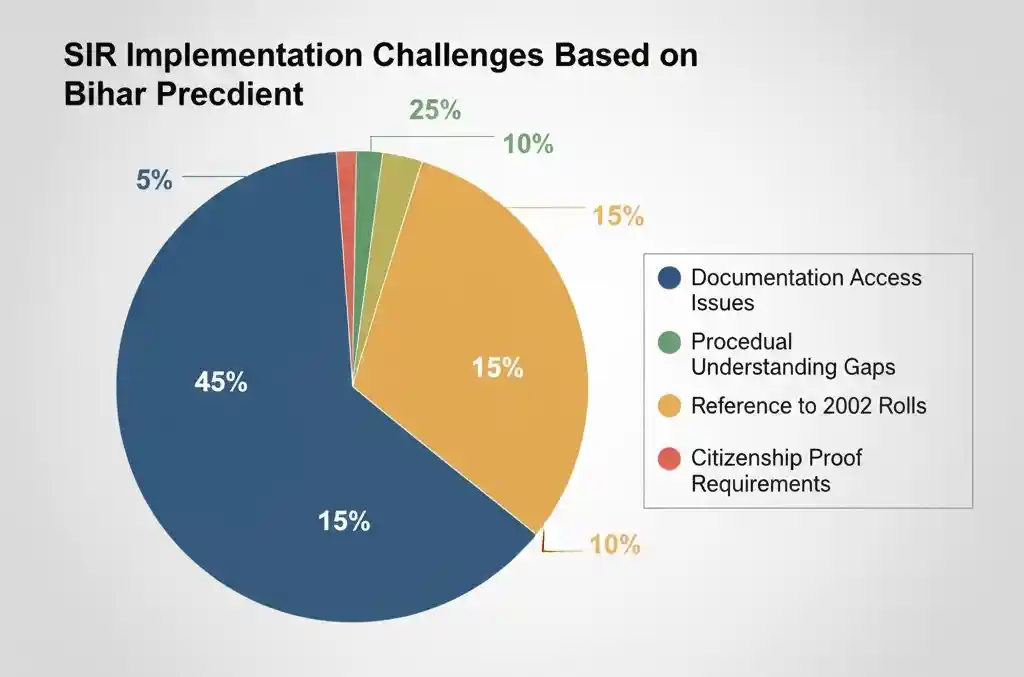
The Bihar SIR experience looms large in current debates, serving as a cautionary tale about potential implementation challenges. During Bihar’s verification exercise, the initial exclusion of Aadhaar cards from acceptable documentation reportedly threatened the voting rights of approximately 30 million legitimate voters, predominantly from impoverished backgrounds. While Supreme Court intervention eventually mandated Aadhaar’s acceptance, the process still resulted in the exclusion of 6.5 million citizens from voter lists despite identifying fewer than 500 “illegal immigrants”.
This dramatic discrepancy between targeted objectives and actual outcomes has intensified concerns about collateral damage in current SIR implementation. The Lal Babu Hussein case (1995) established crucial Supreme Court guidelines prohibiting arbitrary citizenship tests and emphasizing natural justice principles in voter verification. Critics argue that the current SIR process potentially violates these judicial safeguards by creating structural barriers for documented citizens who lack specific paperwork due to administrative or economic constraints.
3.2 BLO Operations and Voter Experiences
The practical implementation relies on Booth Level Officers (BLOs), who bear responsibility for form distribution, collection, and initial verification. These officers represent the human face of the SIR process, navigating complex ground realities while implementing standardized protocols. In Kerala, election officials have urgently requested residential associations to facilitate BLO access, display revision details on notice boards, and encourage resident participation.
The human dimension emerges in the logistical challenges faced by both voters and officials. Elderly residents may struggle to locate decades-old documentation; internal migrants might find themselves caught between registration systems; and illiterate voters could face difficulties navigating form requirements despite assistance provisions. These practical obstacles transcend political debates, highlighting the tension between theoretical policy design and implementation in a country marked by significant diversity in documentation access, literacy levels, and administrative familiarity.
4 Comparative Analysis and Data Presentation
4.1 SIR Versus Traditional Revision Methodologies
The Special Intensive Revision represents a fundamental departure from established electoral roll maintenance practices, with implications for voter participation and administrative burden. Unlike Summary Revisions that use existing rolls as baselines or Intensive Revisions focusing on physical verification, the SIR introduces citizenship documentation requirements previously absent from routine electoral processes. This shift transforms what was primarily an inclusion-focused administrative exercise into a verification-intensive process requiring voters to proactively establish eligibility.
The legal foundation of SIR remains contested, with critics noting that the Representation of the People Act, 1950 and subsequent 1960 Election Rules recognize only Summary and Intensive Revisions without mentioning any Special Intensive Revision authority. The Election Commission’s claim that similar exercises occurred between 1951-2003 has been complicated by its admission that records from the alleged 2003 SIR implementation have been “lost,” further fueling legal and political challenges.
Learn about AI in Election and How it can change complete old parameters
4.2 State-Wise Implementation and Political Landscape
The SIR’s impact must be understood within distinct regional political contexts, with varying implications across the 12 implementing states and union territories. In Tamil Nadu, the process occurs amid heightened political tensions following the DMK’s recent anti-NEET legislative campaigns and the emergence of new political entities like Vijay’s Tamilaga Vettri Kazhagam. West Bengal presents a different dynamic, with the BJP attempting to overcome 2021 setbacks through cultural outreach while the Trinamool Congress leverages administrative control to monitor implementation.
Kerala’s implementation benefits from higher literacy rates and administrative capacity but still faces challenges regarding internal migration and document consistency. The state’s current electoral preparation occurs alongside the Left Democratic Front’s campaign to maintain power against a resurgent United Democratic Front. These distinct political environments ensure that despite standardized national protocols, SIR implementation and impact will vary significantly based on local political dynamics, administrative efficiency, and historical voter enrollment patterns.
Read our complete guide to Indian Electoral Services
5 Conclusions and Strategic Recommendations
5.1 Key Findings and Democratic Implications
The Special Intensive Revision of electoral rolls represents a transformative moment in Indian electoral administration, with potential consequences for democratic representation and political competition. The process affects 51 crore voters across 12 states and union territories, with particular significance for Tamil Nadu, West Bengal, and Kerala where 2026 assembly elections could determine regional political trajectories for the subsequent five years. The documentation emphasis, while theoretically strengthening electoral integrity, risks disenfranchising vulnerable populations who lack consistent access to formal paperwork despite legitimate citizenship claims.
The Bihar precedent, where 6.5 million voters were excluded despite minimal illegal immigrant detection, suggests potential misalignment between stated objectives and practical outcomes. This implementation gap underscores the critical importance of balancing fraud prevention with inclusion, particularly in democracies where unequal document access could systematically disadvantage marginalized communities. The ongoing Supreme Court review will determine the constitutional validity of the SIR framework, but its political consequences will likely resonate through multiple election cycles.
View all our Election Analysis reports
5.2 Recommendations for Stakeholders
Recommendations For Election Administrators:
- Enhance documentation flexibility by expanding acceptable proof options
- Implement comprehensive public awareness campaigns targeting vulnerable demographics
- Establish rapid-response grievance mechanisms for wrongful exclusions
- Ensure transparent procedures with meaningful political party observer participation
Reccomendations For Political Parties:
- Deploy trained booth agents to assist voters with documentation challenges
- Monitor implementation for consistent application of standards across regions
- Develop voter assistance programs focusing on marginalized communities
- Maintain electoral participation as both procedural accuracy and maximal inclusion
Recommendations For Civil Society Organizations:
- Provide neutral voter assistance and documentation support services
- Conduct independent monitoring of inclusion/exclusion patterns
- Facilitate constructive dialogue between competing stakeholders
- Document implementation experiences to inform future electoral reforms
Join Project Nirbhay – Mind Without Border by Indian Council for Politics & Research (ICPR)
The Indian Council for Politics and Research (ICPR) remains committed to evidence-based analysis of democratic processes and electoral governance. Our research team will continue monitoring SIR implementation and its impact on electoral integrity and voter participation across India. We as India’s premier strategic consultancy firm, uniquely positioned at the intersection of traditional political wisdom and cutting-edge artificial intelligence. We strengthen democracy by equipping leaders with accurate data, strategic insights, and technology that empowers better governance. Our pioneering initiatives including Project VEDA (AI-driven voter engagement platform) and Predictive Analysis Tool (election forecasting system) have fundamentally transformed how political campaigns are conceived, executed, and evaluated across India’s diverse electoral landscape.
Explore Customized Electoral Analysis Solutions
Connect With Our Political Research Team
Email: contact@icprindia.com
Let us collaborate to decode electoral complexities through data-driven Political and Social analysis and innovative political research methodologies.
Leave a Reply