
Introduction
The recent four-day military clash in May 2025 between India and Pakistan prompted the USCC to include a significant observation in its 2025
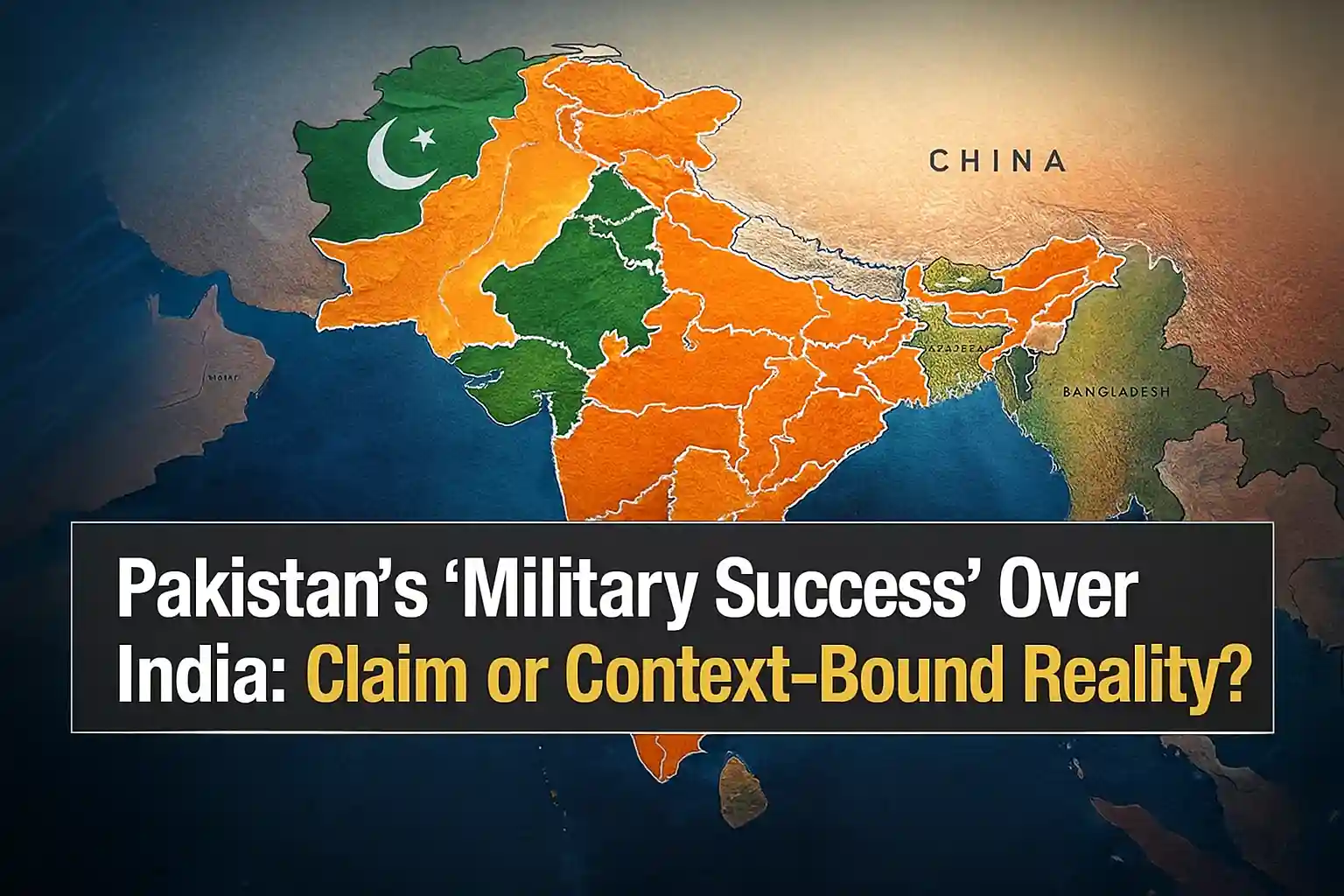
“Pakistan’s military success over India in its four-day clash showcased Chinese weaponry.” The Wire+2US-China Review Commission+2
This sentence – concise yet loaded – has become a diplomatic, military and media flashpoint. Indian media headlines such as “US panel makes big claims on Pakistan’s ‘military success’ over India in May, calls Pahalgam ‘insurgent’ attack” (LiveMint) reflect how this phrase has been publicly received. mint
1. The Claim (Media Framing)
1.1 Indian Media Headlines and Wording
- LiveMint: “US panel makes big claims on Pakistan’s ‘military success’ over India in May, calls Pahalgam ‘insurgent’ attack”. This highlights two points: 1. Pakistan has been credited with military success. 2. The Pahalgam / Kashmir attack is described as an “insurgent attack” rather than a “terrorist attack”. mint
- Times of India: “Why did a US report say Pakistan achieved ‘military success’ over India?” This suggests surprise and asks why the USCC chose this phrase. The Times of India
- Deccan Herald: “US panel’s report claims Pakistan’s success over India in May 7-10 clash, flags China’s use of conflict for advertising weapons”. It uses the word “success” and adds the dimension of China’s exploitation of the clash. Deccan Herald
1.2 What the Claim Implies
From these headlines, the implied narrative is:
- Pakistan gained a measurable victory (or at least advantage) over India in May 2025.
- India suffered a setback (“military success over India”, “Pakistan’s success over India”).
- The USCC report uses precise wording that seems to validate Pakistan’s narrative of the conflict.
- The Pahalgam incident is down-graded from “terrorist attack” to “insurgent attack” in the report’s wording (as perceived by Indian media).
- China is seen as having leveraged this outcome or the conflict to its advantage (highlighted by Deccan Herald).
These claims form the basis for public, political and media narratives. The question is: how accurate are they relative to the underlying report and fact-base?
2. The Report (USCC Wording, Structure & Context)
2.1 Key Report Text
From Chapter 2 (“U.S.–China Security and Foreign Affairs (Year in Review)”) of the USCC 2025 report we find the following relevant passages:
“China’s role in the May 7–10, 2025, clash between Pakistan’s and India’s militaries drew global attention as Pakistan’s military relied upon Chinese weaponry and reportedly leveraged Chinese intelligence. During the clash, triggered by India’s response to a deadly insurgent attack that killed 26 civilians in its contested Jammu and Kashmir region, both countries attacked targets farther into one another’s territories than at any time in 50 years.” US-China Review Commission+2The Wire+2
Followed by: “Pakistan’s military success over India in its four-day clash showcased Chinese weaponry.” The Wire+1
And the report adds: “While characterization of this conflict as a ‘proxy war’ may overstate China’s role as an instigator, Beijing opportunistically leveraged the conflict to test and advertise the sophistication of its weapons, useful in the contexts of its ongoing border tensions with India and its expanding defense-industry goals.” The New Indian Express+1
2.2 Placement and Footnotes
The wording appears on pages approximately 108–109 of the report (per Indian media referencing) though the PDF page numbering may differ. mint+1
The footnotes cite multiple sources: news wires, think-tank analyses, and some foreign intelligence reporting. For example: Footnotes referencing Reuters, AP, New York Times, etc. Also referencing “French intelligence” about disinformation campaigns. US-China Review Commission
2.3 How the Report Frames Its Findings
- The USCC describes the clash as one of the most intense between India and Pakistan in decades, and it emphasises both sides struck deeply into each other’s territory.
- The phrase “military success” is not defined in strict quantitative terms in the relevant paragraph, but is used in conjunction with “showcased Chinese weaponry”.
- The report is clear that China did not initiate the conflict (it says calling it a “proxy war” may overstate the case).
- There is emphasis on how China used the conflict as an opportunity: testing weapons, marketing systems, using disinformation.
- The report uses the word “insurgent attack” rather than explicitly “terrorist attack” when describing the 26-civilian-killed incident; this is neutral language that avoids attributing state sponsorship or terrorism classification.
3. The Fact— What We Know from Open Sources
3.1 The April 22/23 2025 Attack (Pahalgam, Kashmir)
- According to Indian reporting: 26 Hindu pilgrims (mostly male) were killed in the Pahalgam valley in Jammu & Kashmir’s Anantnag district by militants.
- India attributed it to a “Pakistan-based militant group” (and suggested Pakistan’s involvement). Pakistan denied state involvement.
- The USCC’s wording: “a deadly insurgent attack that killed 26 civilians in its contested Jammu and Kashmir region.” That aligns factually with the number and area. The Wire
3.2 The May 7-10 2025 Clash
- Sources show India launched missile/air strikes (Operation Sindoor) in Pakistan or Pakistan-administered Kashmir early May to hit militant camps. Pakistan counter-attacked. Escalation ensued. (See reports from AP and other outlets). AP News
- The USCC states the two sides “attacked targets farther into one another’s territories than at any time in 50 years.” US-China Review Commission
- It notes Pakistani military “relied upon Chinese weaponry and reportedly leveraged Chinese intelligence.” That is a claim based on open-source analysis plus intelligence indicators (footnoted).
- Also, the USCC states that China used the conflict for disinformation/marketing. US-China Review Commission+1
3.3 Evidence of Chinese Weapons / Marketing
- The USCC quotes French intelligence and other open-source investigations about how China ran a “disinformation campaign” after the India-Pakistan clash to undermine French Rafale sales and promote its own J-35 jets. The Wire
- The essence: the use of Chinese weapons in the clash gives Beijing a combat-use case which it then used as a sales/marketing narrative.
3.4 What is not clearly demonstrated in open sources
- A definitive independent audit that Pakistan achieved a full military victory over India in the sense of strategic outcome.
- Detailed breakdown of losses/damage (many claims exist but are contested).
- Clear independent confirmation of Chinese intelligence or command role in the conflict. The USCC says “reportedly leveraged,” not definitively.
- A full public accounting of India’s losses or gains in this clash that both parties accept.
4. Interpretation — What the Report really means (and what it does not mean)
4.1 What the phrase “military success” means here
- Within the context of the USCC paragraph: it refers to a tactical/operational success during a brief, high-intensity exchange (May 7-10) in which Pakistan (according to the Commission’s analysis) achieved noteworthy outcomes – in part due to advanced Chinese weaponry.
- The wording “showcased Chinese weaponry” ties the success to China’s hardware and support, signalling a technology/arms-export dimension rather than purely human or strategic victory.
- The report implies that Pakistan’s performance in that four-day clash was better than India’s (or at least measured as a success) in some respects (e.g., ability to use Chinese weapons, withstand Indian strikes, leverage Chinese support).
4.2 What the phrase does not mean
- It does not say Pakistan achieved a strategic victory over India (e.g., territorial gain, collapse of Indian forces). The report explicitly warns that calling it a “proxy war” would overstate China’s role, which in effect moderates the strength of the claim.
- It does not say India was fully defeated, or that India lost its deterrence posture, or that Pakistan permanently changed the regional balance of power.
- It does not say that India accepted defeat or publicly acknowledged Pakistan’s victory.
- It does not supply a clear quantified metric of “victory” (e.g., numbers of aircraft downed, territory captured) in that sentence — those details are implicit and subject to contested claims.
4.3 Strategic and symbolic implications
From an interpretive viewpoint:
- The USCC’s choice of language is significant because it is one of the few Western-institutional assessments that frames Pakistan as achieving success (even if limited) in a dispute with India – this may affect external perceptions of India’s military strength and Pakistan’s defence posture.
- The linkage of Pakistan’s success with the use of Chinese weapons or Chinese intelligence support signals a broader strategic message: China’s defence exports/weapon-testing ecology are gaining combat credibility and may shift regional arms-dynamics.
- For India, this phrasing creates reputational and diplomatic concerns: Indian media and opposition parties portray it as a blow to Indian deterrence and military narrative.
- For ICPR and similar strategic-policy organisations, the report offers a prompt to re-evaluate assumptions about India’s force readiness, supply-chain dependencies (e.g., on Western platforms), and the evolving Sino-Pakistan axis.
4.4 Why the Indian media focus the way they do
- The phrase “Pakistan’s military success” is inflammatory in the Indian political context because Indian military/defence narratives emphasise consistently that India has battlefield superiority over Pakistan (e.g., 1971, Kargil, surgical strikes).
- The headline wording (LiveMint, Times of India) emphasises the claim and interprets it as a reversal or challenge to India’s self-image.
- The media also pick up the “insurgent attack” wording (instead of “terrorist attack”) because it seemingly down-grades India’s narrative about the Pahalgam incident — Indian media see this as part of a larger diplomatic loss.
5. Media Coverage: Indian, Pakistani and International
5.1 Indian Media
- LiveMint headline: “US panel makes big claims on Pakistan’s ‘military success’ over India in May, calls Pahalgam ‘insurgent’ attack.” This article quotes the USCC verbatim: “Pakistan’s military success over India in its four-day clash showcased Chinese weaponry.” mint
It emphasises the diplomatic backlash in India: Congress MP Jairam Ramesh called the report “a severe setback” for India’s diplomacy. - Times of India article: “Why did a US report say Pakistan achieved ‘military success’ over India?” It discusses the specific language, the footnotes, and the reaction from Indian defence/media circles that this phrase is extraordinary. The Times of India
- Deccan Herald: The headline emphasises the USCC’s dual claim: Pakistan’s success + China’s use of the conflict for arms advertising. It shows Indian media linking the USCC language to China’s broader strategy. Deccan Herald
5.2 Pakistani/Regional Media
- Defence Security Asia: “Pakistan’s May 2025 Victory Over India Validates Chinese Weapons: New US Congressional Report Reveals Strategic Turning Point”. Its rhetorical framing goes further — it treats the USCC language as validation of Pakistani victory and Chinese weapons dominance. Defence Security Asia
- Regionally, some Pakistani outlets highlight the USCC phrase “military success” as vindication of Pakistan’s claims about the conflict.
5.3 International Media
- TRT World: “US Commission acknowledges Pakistan’s military success over India in May clash”. It plainly reports the USCC wording. TRT World
- Outlook India: “US Report Says China Used India-Pakistan Clash to Test Its New Weapons”. It quotes the USCC’s claim about China’s opportunistic exploitation of the conflict. Outlook India
5.4 Observations on Terminology
- Indian media emphasise ’military success’ (quoting the USCC) and interpret it as a blow to India’s image.
- Indian media also pick up the ‘insurgent attack’ phrasing for Pahalgam and raise concern at the possible diplomatic/cognitive shift.
- Pakistani/regional media adopt the phrase as validation of Pakistani claims, sometimes using stronger rhetoric (“victory”, “turning point”) than the USCC itself.
- International media largely stick to objective reporting — quoting the USCC sentence and noting reactions — but some (e.g., Defence Security Asia) amplify the broader strategic implications heavily.
6. Fact vs Interpretation & What to Watch
6.1 Facts
- The USCC report uses the phrase “military success over India”, and attributes it to Pakistan in the four-day clash of May 2025.
- It also describes the Pahalgam incident using “insurgent attack”.
- The report links that clash to Chinese weapons, Chinese material support, and Beijing’s strategic use of the crisis.
- The report does not call the clash a full war victory for Pakistan, nor does it quantify the success.
6.2 Interpretations
- Claiming Pakistan had “military success” suggests Pakistan’s armed forces performed effectively in that specific engagement – especially using Chinese systems.
- From the Indian perspective, the wording is seen as a reputational setback because it appears to credit Pakistan with an advantage in a conflict India initiated.
- From the Pakistani perspective, the phrase becomes a narrative lever, used to assert that Pakistan achieved something the world didn’t recognise earlier.
- For China, the report’s emphasis on its weapons and the disinformation/marketing angle reinforces Beijing’s narrative of Chinese-made systems proving themselves in combat.
6.3 What to be Cautious About
- Equating “military success” with “strategic victory”: the report lacks language that Pakistan won the war, captured territory, or reversed strategic outcomes. To interpret “success” as full victory would go beyond the report’s wording.
- Assuming India suffered a definitive defeat: the India-Pakistan conflict of May 2025 remains contested; many claims (losses, strikes) are unverified, disputed or denied.
- Ignoring the caveats: the USCC itself acknowledges that characterising the event as a “proxy war” may overstate China’s role; thus the report leaves room for interpretation.
- Ignoring the broader context: The clash must be set against decades of India-Pakistan conflict, where Pakistan has historically not achieved strategic victory. A short-term tactical success does not rewrite the broader historical balance.
7. Implications for ICPR Research & Strategic Briefing
7.1 For ICPR’s Election / Defence & Security Pillar
- Use this report’s language (“military success”) as a monitoring indicator: if Pakistan, supported by China, is increasingly able to demonstrate battlefield outcomes, India’s defense planners should review assumptions about force readiness, supply-chain dependencies (especially weapons/platforms), and intelligence equilibrium.
- Use the incident as case-study material: the May 7–10 clash can be analysed as a modern hybrid/air-missile-drone confrontation, and the USCC’s focus on Chinese weapons offers an avenue to explore India’s comparative vulnerability in emerging technologies.
- Prepare open-source briefings for Indian policymakers that highlight how external assessments (like the USCC) may influence perceptions of regional balance — not only domestically, but in external investors, arms markets, and partner countries.
7.2 For ICPR’s Media & Public Outreach
- Develop communication briefs that address this phrase in India’s public narrative – e.g., “What exactly did the USCC mean?” – helping clarify to policymakers and public that “military success” is limited in scope.
- Provide fact-checks: comparing what the USCC actually wrote versus how the headlines interpret/expand it.
- Create visual dashboards: mapping escalation events, weapons used, reported losses/damage, timeline of the May 2025 clash, and cross-referencing with USCC citations.
7.3 For Comparative Analytics & Strategic Models
- Embed the USCC wording into threat-scenarios: for example, scenario modelling where Pakistan uses Chinese weapons to gain short-term advantage, forcing India to respond (costs, timelines, escalation risks).
- Use supply-chain dependency data (Chinese weapons to Pakistan; Indian dependency on Western/foreign platforms) to model “what-if” situations where India’s vulnerabilities are exposed.
- Include an influence-campaign overlay: The USCC’s mention of disinformation and arms-marketing suggests that non-kinetic outcomes (reputation, arms export market) are part of the competition.
Conclusion
The 2025 USCC report’s phrasing – “Pakistan’s military success over India in its four-day clash showcased Chinese weaponry.” – is both significant and nuanced. Media headlines in India, Pakistan and internationally have picked up the phrase because it carries heavy symbolic weight, but their interpretations diverge: Indian coverage sees a reputational challenge to India; Pakistani/regional media interpret it as vindication; international outlets highlight the China dimension.
For ICPR and other strategic research organisations, this phrasing is a valuable entry-point for deeper exploration: what does “success” mean operationally? How did Chinese support timing, weapons or intelligence play a role? What does it mean for India’s force preparedness, strategic posture, supply-chain resilience and information warfare readiness? The USCC caution that the term may overstate China’s role reminds researchers to maintain rigorous nuance: this is not a statement of full strategic defeat for India – but nor is it a trivial footnote. It is an indicator of shifting dynamics.
In sum, the phrase encapsulates a modern battle-front where tactical outcomes, weapons efficacy, supply-chain leverage and information operations all intersect. For India and ICPR’s mission of strategic political research, the task is not only to rebut or accept the phrase, but to unpack why it was used, what evidence supports it, and what future implications follow.
Leave a Reply