
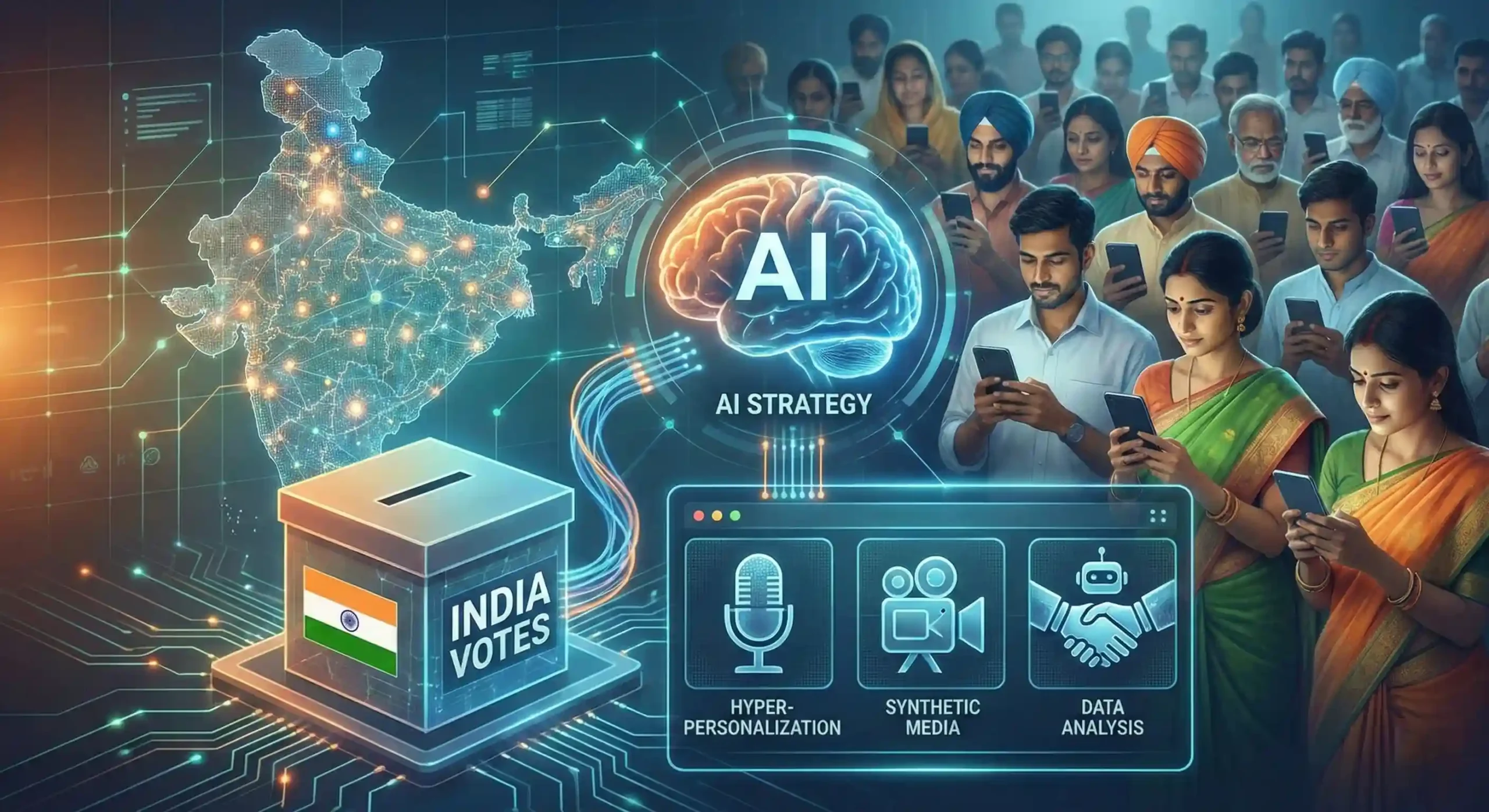
AI is quietly powering a ₹5,000–6,000 Cr market for data‑driven campaigning in India. From predictive booth‑level models and micro‑targeted content to multilingual deepfake avatars and real‑time sentiment dashboards.
1. From intuition to intelligence: why AI now dominates Indian campaign strategy
India’s 2024 general election and subsequent state contests marked a structural break. AI moved from an experimental add‑on to the central nervous system of major campaigns. Parties and political technology firms now use AI for end‑to‑end election strategy – from voter profiling and booth‑level forecasting to AI‑generated videos and automated war‑rooms – fundamentally changing how campaigns are designed, executed, and measured. cppr
Multiple studies document this shift. Academic analyses of Indian campaigns highlight AI’s role in large‑scale data analysis, sentiment tracking, and micro‑targeted communication. As the new differentiator between “professionalised” and traditional campaigns. Policy papers on generative AI and India’s 2024 elections show that AI‑generated avatars, deepfakes, and customised media were deployed both to enhance voter engagement and to amplify propaganda and misinformation. dgap
For Indian party strategists and senior campaign managers, this means election strategy can no longer be built only on experience. Caste arithmetic, or gut feel. It must be anchored in robust data pipelines, machine‑learning models, and governance frameworks. That translates AI outputs into politically actionable decisions. thewire
2. Mapping the AI election stack: how campaigns actually use AI
2.1 Data foundations: building the AI‑ready election dataset
An effective AI election strategy begins with data engineering, not dashboards. Research on Indian election campaigning shows that parties already aggregate:
- Electoral data: booth‑wise results, turnout, NOTA, victory margins, and swing patterns over multiple cycles.
- Demographic and socio‑economic data: census variables, caste‑community patterns, urban‑rural split, income and occupation proxies, welfare scheme coverage.
- Digital behaviour signals: social media engagement, search trends, influencer networks, and issue‑specific conversation clusters.
- Field and survey data: structured surveys, door‑to‑door feedback, call‑centre logs, and complaint systems.
AI models depend heavily on how well this fragmented data is cleaned, linked, and refreshed. Serious Indian political tech platforms explicitly position themselves as “AI‑driven command centres” that unify booth‑level data, demographics, sentiment, and campaign activity into one system. Without this layer, later claims about “AI‑powered campaigns” are mostly cosmetic.
2.2 Predictive analytics and psephology 2.0
Recent Indian research and industry offerings show that election forecasting has moved beyond simple swing analysis to multi‑model machine‑learning approaches. Tools commonly used include:
- Classification models (Logistic Regression, Random Forests, Gradient Boosted Trees, SVM) to predict win probabilities, vote shares, or support likelihood at constituency and booth level.
- Turnout and mobilisation models that estimate which booths, communities, and regions are at risk of low turnout and what incremental effort could shift the outcome.
- Scenario simulators that test alliances, candidate changes, and issue swings, allowing leadership to “war‑game” election outcomes before committing resources.
Academic comparisons of electoral prediction algorithms underscore that model choice matters. Some models handle noisy Indian data and non‑linear relationships better. While others are more interpretable and therefore more acceptable to senior political decision‑makers. For strategists, the real value is not a “magic number” but the ability to rank constituencies. Booths by winnability, persuadability, and the expected return on each additional rupee or worker shift.
2.3 Voter profiling, micro‑targeting, and the Indian electorate
Studies of AI in Indian campaigns consistently highlight micro‑targeting as one of the most powerful – and controversial – applications. AI systems integrate electoral rolls, demographics, social media behaviour, and consumer‑like data to:
- Cluster voters into micro‑segments based on caste‑community, age, gender, income, religion, locality, language, and issue priorities.
- Score individuals or households on support (pro/anti/swing), persuadability, and turnout risk, giving campaign managers a clear map of who to persuade, who to mobilise, and whom to deprioritise.
- Identify “hidden” clusters (e.g., first‑time urban voters, women beneficiaries of a specific scheme) that are electorally important but under‑engaged in traditional booth‑level politics.
Analyses of micro‑targeting in India stress both its efficiency and its risks. It enables “laser‑precision” messaging that can boost campaign ROI, but also raises concerns about invisible manipulation. Discrimination when data subjects do not understand how they are being targeted. For responsible strategists, this makes transparency and internal checks as important as raw predictive power.
2.4 Sentiment analysis and real‑time narrative management
AI‑based sentiment analysis proved central to campaign strategy in the 2024 Indian elections, with parties using NLP models to monitor millions of posts, comments, and articles across platforms. Key capabilities include:
- Real‑time measurement of sentiment (positive/neutral/negative) for leaders, parties, policies, and narratives.
- Issue and trend detection, identifying what new topics are gaining traction in specific geographies or communities.
- Influencer mapping, pinpointing local accounts that drive conversation in a district or community.
International and Indian policy work on AI in elections notes that these tools allow parties to adjust talking points, deploy surrogates, and counter narratives within hours rather than days. However, sentiment systems are only as good as their training data and language coverage. Which is a serious concern in India’s multi‑lingual, dialect‑rich environment.
2.5 Generative AI, avatars, and the rise of synthetic campaigns
The most visible shift in Indian electioneering has been the explosion of generative AI content: AI‑generated avatars, videos, and audio used for both legitimate outreach and misleading propaganda. Documented 2024 use‑cases include:
- AI‑generated “avatars” of leaders speaking directly to voters in different Indian languages and dialects, enabling hyper‑personalised communication at scale across hundreds of millions of voters.
- Deepfake and synthetic videos mocking opponents or glorifying leaders, sometimes reviving deceased political icons or manipulating scenes to trigger emotional reactions.
- Infinite creative versioning – the same core message automatically adapted into hundreds of short videos, memes, and banners for specific communities and constituencies.
Policy analyses emphasise the dual nature of this trend: generative AI can dramatically deepen engagement and localisation, but also supercharge disinformation and erode trust in authentic media. For campaign leadership, this creates a strategic imperative to build both offensive (content production) and defensive (deepfake detection, rapid rebuttal) capabilities.
2.6 AI‑driven campaign operations and field optimisation
Election‑tech platforms in India increasingly pitch themselves as “war‑room operation systems” that translate AI insights into daily tasking for field teams. Typical features include:
- Live dashboards showing booth‑level campaign health, volunteer activity, message penetration, and resource deployment.
- Recommendation engines suggesting where to send star campaigners, organise roadshows, or run targeted phone/WhatsApp outreach based on predicted impact.
- Chatbots and virtual assistants that respond to citizen queries, collect structured feedback, and feed that data back into models.
In this model, AI is not just an analytics layer; it actively orchestrates daily campaign execution. Research on AI in politics warns that over‑reliance on such systems without human oversight could produce blind spots or misaligned incentives, especially when models are optimised for engagement rather than long‑term legitimacy.
3. Market size and emerging ecosystem: towards a ₹5,000–6,000 Cr AI‑driven election industry
The Indian AI‑in‑elections ecosystem now spans political consultancies, mar‑tech firms, AI start‑ups, survey organisations, and platform‑based “AI command centres”. Reports and industry commentaries describe an election‑campaign technology market – strongly driven by AI and data analytics – in the ballpark of ₹5,000–6,000 crore when counted across parties, candidates, and election cycles.
Key ecosystem components include:
- Integrated AI campaign platforms: solutions like Rajyatantr’s “Arthashastra”, which bundle voter insights, predictive modelling, and real‑time campaign execution tools tailored for Indian elections. [m.thewire]
- Specialist AI content providers: firms offering AI video, voice‑cloning, and avatar services in 100+ languages and dialects for Indian political campaigns.
- Data and sentiment firms: companies providing social listening, influencer mapping, and NLP sentiment analysis tuned to Indian political discourse.
- Academic and civil‑society labs: groups studying AI’s impact on elections, democratic integrity, and regulatory frameworks, often influencing future norms.
This ecosystem is expanding as India’s broader AI market grows and as upcoming state and national elections make “tech lag”. A competitive danger for parties that under‑invest in data‑driven capabilities. For ICPR’s audience, the key insight is that AI election strategy is no longer a luxury; it is a cost of staying electorally credible.
4. Strategic implications for Indian parties and coalitions
4.1 Advantages for early AI adopters
Research and case‑based evidence suggest that parties intelligently integrating AI into campaign strategy are likely to enjoy three main strategic advantages:
- Superior seat and resource selection: model‑driven prioritisation helps choose the right seats, candidates, and alliances, improving “seats per vote and rupee” metrics.
- Deeper, more targeted voter engagement: micro‑segmented, language‑tailored messages build the perception of attentiveness and relevance in an electorate of nearly one billion voters.
- Faster response cycles: sentiment analytics and narrative tracking reduce response times to attacks, crises, and opportunities from weeks to hours.
These advantages compound across cycles, as parties that invest in data and AI accumulate historical datasets and modelling experience, widening the gap with late adopters.
4.2 Organisational changes required
However, research also makes clear that AI deployments fail when organisations treat them as external “black boxes” rather than internal capabilities. To fully leverage AI, parties must:
- Build internal analytics and digital teams that can co‑design models with vendors, interrogate outputs, and translate them into politically meaningful actions.
- Institutionalise data governance, including data quality audits, privacy safeguards, and clear lines of responsibility for AI‑driven decisions.
- Train district and booth‑level leadership to interpret dashboards and micro‑targeting plans, ensuring that AI insights actually change on‑ground behaviour.
This organisational re‑wiring is arguably harder than procuring tools, which is why many early AI efforts remain underutilised despite impressive technology.
5. Ethics, risk, and regulation: managing the dark side of AI campaigning
5.1 Deepfakes, disinformation, and psychological targeting
Multiple reports on India’s 2024 elections warn that AI has dramatically lowered the cost of sophisticated manipulation. Key concerns include:
- Deepfake videos and audio are used to spread false statements, incite anger, or undermine trust in opponents.
- Hyper‑targeted propaganda tailored to vulnerable groups (e.g., youth, minorities, marginalised communities), exploiting anxieties and cognitive biases.
- Flooding of social media with AI‑generated content and bots, creating artificial trends and a false sense of majority opinion.
Scholars argue that such practices can erode informed consent, polarise society, and damage long‑term democratic legitimacy even if they deliver short‑term electoral gains.
5.2 Data privacy and invisible micro‑targeting
Legal and policy research in India highlights the tension between micro‑targeting and voter privacy. AI‑driven targeting often rests on inferred attributes (e.g., caste, religion, ideology) combined with sensitive behavioural data, without clear voter awareness or consent. This raises three major issues:repository.
- Lack of transparency: voters rarely know why they are seeing a particular political message or which data points were used to target them.
- Collective harms: even if individual‑level privacy is nominally protected, whole communities can be stereotyped or selectively targeted in ways that distort democratic representation.
- Regulatory lag: current Indian frameworks are still catching up to the realities of AI‑driven political advertising and profiling.
5.3 Regulatory and normative responses
International and Indian policy papers converge on the need for stronger guardrails around AI in elections. Recommended directions include:
- Mandatory labelling of AI‑generated political content and enforcement against deceptive deepfakes.
- Transparency obligations for platforms and parties about targeting criteria and data sources in political advertising.
- Collaborative standard‑setting among election authorities, parties, tech firms, and civil society to balance innovation with electoral integrity.
For responsible strategists, anticipating these rules and building internal ethics frameworks is not just about compliance; it is a brand and trust advantage in a sceptical, information‑saturated electorate.
6. A strategic AI roadmap for Indian parties
Based on the emerging literature and case evidence, Indian parties seeking to institutionalise AI‑driven, data‑first campaigning can think in four phases:
1st Phase: Data and governance foundation
- Consolidate electoral, demographic, and campaign data into a unified, secure repository with robust access controls.
- Establish a party‑level AI and data ethics charter covering consent, privacy, deepfakes, and prohibited manipulation tactics.
- Create a small, empowered analytics core team to coordinate with external vendors and political leadership.
2nd Phase: Descriptive and diagnostic analytics
- Build dashboards for basic descriptive metrics: vote trends, turnout, booth performance, and demographic patterns.
- Deploy social listening and sentiment analysis to understand current narratives, influencers, and issue salience by geography and community.
- Run diagnostic studies on past elections to identify systematic blind spots and underserved segments.
3rd Phase: Predictive and prescriptive AI
- Introduce predictive models for seat/booth winnability, turnout risk, and swing segment identification.
- Use micro‑targeting frameworks to design segmented messaging, mobilisation, and alliance strategies.
- Build recommendation engines that translate AI insights into field‑level tasking (rallies, outreach, digital pushes).
4th Phase: Generative and adaptive campaigns
- Deploy generative AI for multilingual content, video avatars, and personalised outreach with clear labelling and internal review.
- Implement deepfake detection and rapid‑response protocols for misinformation targeting the party or its leaders.
- Continuously retrain models using feedback from each campaign cycle, converting experience into institutional learning rather than one‑off gains.
7. Conclusion: towards responsible AI‑first election strategy
Evidence from the 2024 Indian general elections and the global “super election year” experience confirms. AI is no longer peripheral to election strategy; it is central to how modern campaigns understand voters, shape narratives, and deploy resources. For Indian parties and coalitions, the strategic question is not whether to use AI, but how to build an AI‑first, data‑driven campaign ecosystem. That maximises electoral impact while protecting democratic legitimacy and citizen trust.
ICPR’s positioning at the intersection of AI, psephology, and public policy places it in a unique space to help parties design this next generation of campaigns. Strategy, blending rigorous data science with political nuance and ethical guardrails tailored to India’s complex democracy. icprindia
Leave a Reply