
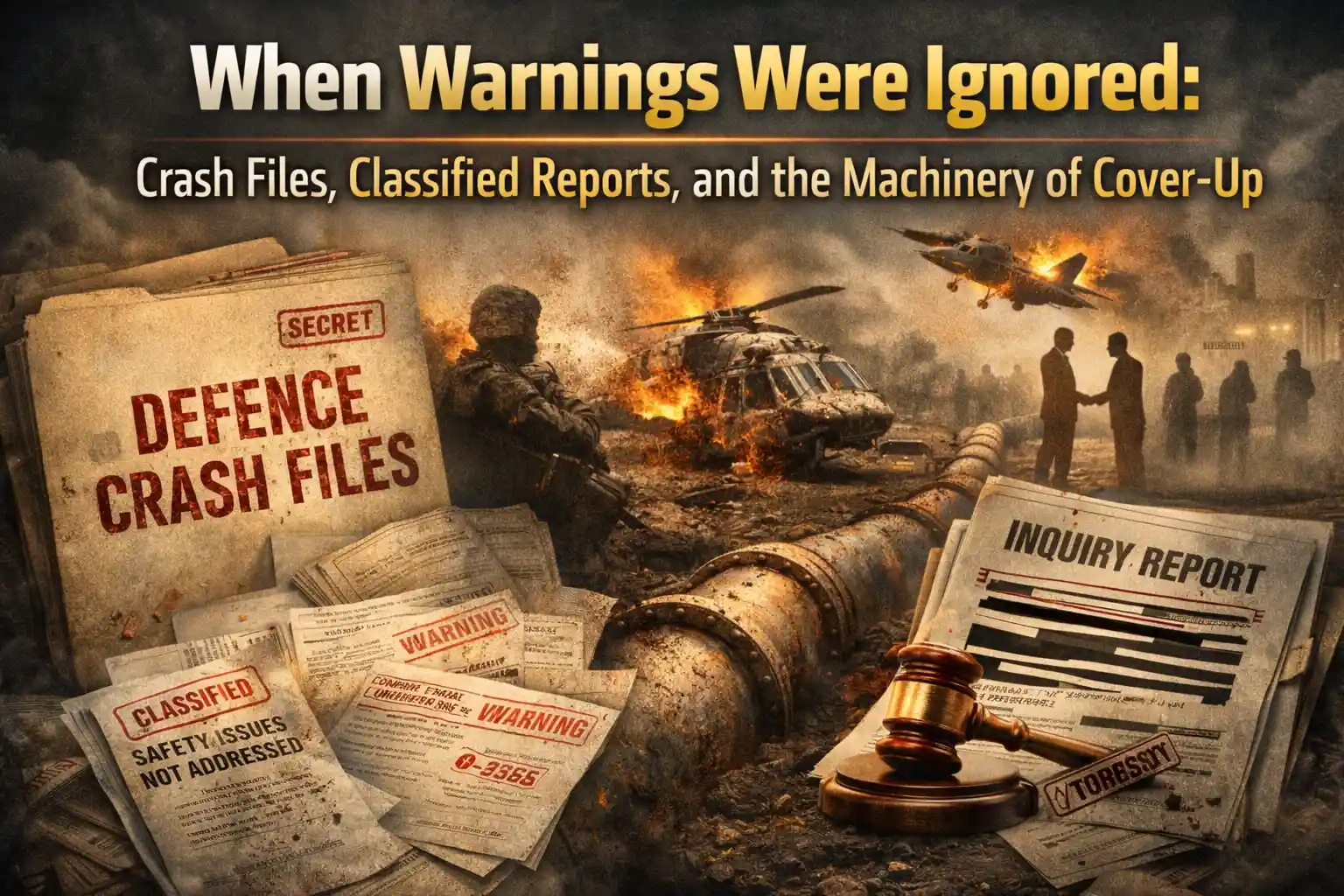
How India’s defence system learned to absorb fatalities without correcting failure
India’s defence sector generates extensive documentation in the form of audit reports by the Comptroller and Auditor General (CAG). Defence ministry annual reports, and parliamentary committee proceedings, which collectively highlight recurring issues in quality control, safety, and oversight in defence public sector undertakings and services. Public narratives often frame accidents as isolated incidents, yet official audits and parliamentary material show repeated references to systemic weaknesses, procedural lapses, and delayed corrective action in defence production and operations. cag
Recent CAG reports on Defence Public Sector Undertakings (DPSUs) document rejected ammunition lots, expose quality‑control failures, and highlight missed opportunities to analyse root causes. Showing that officials frequently note warning signs in files but fail to leverage them for systemic learning. Parliamentary Standing Committee on Defence reports and media coverage of House panel findings reveal that authorities have formally attributed a significant proportion of recent Indian Air Force crashes to “human error,” while secrecy surrounding military investigations keeps broader structural and institutional safety issues outside public scrutiny. theprint
This report draws on:
- CAG audit reports and press notes on defence services and DPSUs. cag+2
- Parliamentary Standing Committee on Defence documents and reporting based on these committee findings. prsindia+3
- Open‑source legal and academic analysis of military aircraft investigations in India and proposals for independent safety bodies. rmlnlulawreview+1
- International civil aviation safety standards, notably ICAO Annex 13, on transparency and investigation practices. applications.icao+4
- Media reporting on defence accidents and parliamentary panel assessments of accident causes. deccanchronicle+4
ICPR builds its analytical framing and policy proposals on defence governance, transparency, and accountability on this documentary base, and further elaborates them in its own research outputs hosted at:
- ICPR defence and governance research index: https://www.icprindia.com/reports/
1. India’s Hidden Defence Safety Archive: What the Public Cannot See
In civil aviation, accident investigation frameworks guided by ICAO Annex 13 require authorities to issue preliminary and final investigation reports. They expect investigators to make the final report publicly available to support safety learning. The Aircraft Accident Investigation Bureau (AAIB) of India, which handles civil aviation occurrences, states that it prepares final accident reports through a formal process, approves them, and generally releases them in the public domain. ffac+4
Military aviation authorities in India conduct accident investigations under internal service procedures (such as Courts of Inquiry). Generally withhold the resulting reports from the public-a gap that legal and academic commentary has repeatedly highlighted in discussions on jurisdictional conflicts and transparency in military aircraft investigations. CAG notes that security classifications limit defence‑sector audits and restrict how much evidence auditors can disclose in public reports. ICPR, in its defence governance work, argues that India’s failure to maintain a public, searchable database of military accidents and investigation outcomes creates a major governance and learning deficit and demands statutory reform. forumias+5
2. Recurring Warning Patterns: Documented, Yet Weakly Followed Up
Across CAG compliance audits on defence production and ammunition, auditors repeatedly identify quality deficiencies. Order the destruction of rejected lots, and observe that officials and vendors fail to conduct detailed root‑cause analysis. If they take timely corrective action-resulting in lost opportunities for preventive learning. In a 2025 CAG report on Defence Public Sector Undertakings, auditors state that authorities burned rejected ammunition lots worth several crore rupees. This happen without thoroughly analysing the reasons for rejection, they explicitly highlight this as a missed opportunity to reduce the risk of similar rejections or failures in the future. cag+2
Parliamentary Standing Committee documents frequently review delays, procedural lapses, and follow‑up actions in defence organisations, underscoring that recommendations are often advisory and that implementation and monitoring of corrective actions remain variable. Within this broader pattern, ICPR’s synthesis of open‑source material and expert interviews identifies five broad categories of “warning‑type” information that recur in official documentation and commentary: eparlib.sansad+3
- Component fatigue and vibration‑related concerns
- Legal and academic analyses of Indian military aircraft accidents, particularly in legacy platforms and MiG‑21‐type cases, discuss technical and structural factors, including ageing fleets and maintenance-related vulnerabilities, which can manifest as recurring technical warnings before serious incidents. indjaerospacemed+2
- Maintenance and overhaul delays
- CAG defence audit reports show that DPSUs and associated entities delayed or inadequately executed maintenance, overhaul, and quality‑assurance processes, creating risks for the reliability and safety of the equipment and ammunition they supplied. cag+2
- Design limitations acknowledged in official documentation
- Parliamentary and audit discussions on indigenous platforms and defence R&D repeatedly acknowledge technological and design challenges in indigenously developed systems and subsystems, showing that officials recognise certain limitations in their own paperwork even when detailed technical data are not publicly available. sansad+2
- Interim operational restrictions and procedural mitigations
- Patterns reported in defence commentary and legal scholarship suggest a reliance on interim procedural controls (such as operating restrictions, advisories, or temporary workarounds) when structural or design-level fixes would be more durable, although granular details of such directives are not usually disclosed publicly. rmlnlulawreview+1
- Audit flags are not automatically linked to grounding or procurement termination
- CAG audits have repeatedly flagged quality deficiencies, contract management lapses, and inadequate follow‑up on rejected lots, but these findings do not, by themselves, trigger automatic grounding of fleets or cancellation of contracts; such decisions depend on separate executive and service processes. cag+2
3. Helicopter Crash Narratives and Fragmented Corrective Actions
3.1 Human Error–Centric Explanations in High‑Profile Crashes
Media reports on a Parliamentary Standing Committee on Defence assessment of 34 Indian Air Force accidents between 2017 and 2022 state that officials attributed more than 50 percent of these crashes to “human error,” including the 2021 Mi‑17V5 crash that killed the Chief of Defence Staff General Bipin Rawat. The same reporting and related coverage of the panel’s findings note that other causes cited include technical defects, foreign object damage, and bird strikes, while some accidents remain under investigation. indiatoday+3
In the Rawat crash case specifically, both Indian Air Force communication and subsequent parliamentary discussion reported in national media emphasized spatial disorientation in adverse weather conditions, ruling out technical malfunction, sabotage, or negligence by IAF personnel. This illustrates how officials actively promote a causal narrative that compresses complex technical, organisational, and environmental factors into the single label of “human error” in high‑level documents and press accounts. southasiajournal+3
ICPR’s analysis situates such cases within a broader pattern where incident narratives prioritise closure around pilot or crew factors, while detailed data on technical warnings, maintenance history, and systemic conditions remain inaccessible due to classification or non‑disclosure. icprindia
3.2 Classification and Limited Public Insight
Legal commentary on jurisdictional conflicts in military aircraft investigations notes that Courts of Inquiry operate under defence service regulations and that their findings are not subject to the same publication obligations as civil investigations under AAIB/ICAO frameworks. Articles critiquing India’s broader aviation investigation system argue that limited investigative independence and transparency undermine safety oversight, and they call for a clearer separation between safety investigations and departmental hierarchies.forumias+1
Together, these analyses show that classification rules and institutional control over military accident investigations actively restrict external scrutiny of causal chains, limiting the ability of families, civil society, and technical communities to independently assess whether recurrent warnings were systematically addressed.ICPR’s research stance is that this secrecy creates a structural obstacle to “learning from failure” in defence aviation. rmlnlulawreview+2
4. Ammunition Failures: Internal Findings and Missed Learning
CAG’s 2025 audit report on Defence Public Sector Undertakings documents specific instances where ammunition lots were rejected during proof and quality checks, with large quantities subsequently burnt or destroyed without a detailed technical investigation into root causes, forfeiting the chance to reduce future defects. The report notes, for example, that rejected lots worth over ₹4 crore were destroyed after proof failures and that delays and procedural lapses led to time‑barred claims against vendors, resulting in avoidable financial loss and unresolved questions about underlying quality problems. cag
Other defence‑related compliance audits similarly point to cases where disagreements over proof results and communications between ordnance factories and quality assurance directorates delayed remedial actions and claims, again highlighting the fragility of feedback loops that should turn failure events into structured learning. Parliamentary committee reviews of ordnance factories and quality assurance agencies also draw attention to persistent quality and coordination issues in the defence production system. ICPR’s policy commentary uses these documented episodes to argue that the current structure disperses responsibility and allows serious safety‑relevant warnings to be absorbed administratively without systematic accountability. sansad+6
5. The “Human Error” Narrative: Administrative Convenience or Systemic Evasion?
5.1 Documented Prevalence of Human Error Attributions
An analysis published in the Indian Journal of Aerospace Medicine notes that human error accounts for more than half of fatal aircraft accidents in the Indian Air Force over the examined period, reflecting a global pattern where human factors play a large role in aviation safety. More recent media reporting on a parliamentary committee report indicates that, between 2017 and 2022, over 50 percent of 34 IAF aircraft accidents were categorised as due to human error (including aircrew and servicing errors). indiandefensenews+4
In civil aviation, ICAO Annex 13 and associated manuals emphasise that human factors should be assessed within the broader system context-encompassing design, maintenance, training, organisational culture, and regulatory oversight-and that investigation reports should aim to prevent future accidents rather than assign blame. ICPR’s reading of the available military accident record and public communication suggests that public narratives in India often compress this systemic picture into a single label of “human error,” without publicly accessible data on how technical and organisational factors were evaluated. unitingaviation+7
5.2 Why the Narrative Persists
International guidance on safety occurrence investigation stresses that the primary objective of investigations is to identify causes and contributing factors to prevent recurrence, not to apportion blame, which requires a culture that tolerates candid reporting and transparent publication of findings. In India’s military aviation domain, the combination of internal inquiry mechanisms, classification practices, and limited external oversight can create incentives to frame incidents in ways that achieve administrative closure while minimising reputational damage, a concern highlighted by legal scholars and policy commentators. ICPR’s aviation safety culture review argues that this construct undermines the development of a genuinely “just culture” in defence aviation where systemic weaknesses are openly acknowledged and addressed. skybrary+6
- ICPR Aviation Safety Culture Review:
The Hidden Crisis of Sub-Standard Defence Production in India
6. Institutional Incentive Structures That Prevent Learning
Academic and policy analysis of India’s aircraft accident investigation regime argue that existing arrangements-split between AAIB for civil aviation and Courts of Inquiry for military aircraft-create jurisdictional overlaps, limited transparency, and weak integration of civil safety expertise into military investigations. Proposals in this literature include establishing a unified or hybrid independent investigation body, or at least formal joint investigation protocols, to reduce institutional self‑investigation and strengthen accountability. spsairbuz+2
Internationally, independent safety boards-such as those operating under robust mandates in other jurisdictions designed to separate investigation from operational and procurement chains, with powers to publish reports and issue safety recommendations that carry significant moral and political weight. CAG reports, for their part, repeatedly flag structural deficiencies in procurement, quality assurance, and follow‑up mechanisms in defence, but do not by themselves create automatic legal or contractual consequences; their impact depends on executive and parliamentary action. ICPR’s governance work frames this as an “incentive problem”: the costs of ignoring warnings are diffused, while the career and institutional incentives often favour minimising controversy. skybrary+6
- ICPR Governance White Paper 2025:
How India’s Defence Industrial System Became a High-Risk Zone
7. Parliamentary Oversight: Retrospective, Not Preventive
Parliamentary Standing Committee on Defence and Public Accounts Committee reports engage with defence procurement, quality, and organisational issues mainly after events have occurred or after the CAG has submitted audit findings. These committee reports are influential in shaping public debate and recommending reforms, but their recommendations are advisory and require executive acceptance and follow‑through; committee documents often record partial or delayed implementation of earlier recommendations. prsindia+3
Media coverage of recent committee reports on air accidents demonstrates this retrospective pattern: the committee assesses causes over a multi‑year period and calls for improvements, yet the underlying investigation reports and detailed technical evidence remain classified or redacted, limiting parliament’s ability to act as a preventive oversight body in real time. ICPR assesses that parliamentary oversight, while vital, is structurally constrained by information asymmetry and the non‑binding nature of its recommendations in the defence domain. theprint+4
8. The Moral Hazard of Classification
ICAO standards and best‑practice guidance underline that transparency in accident reporting-including the publication of final reports and safety recommendations, is central to global learning and continuous improvement in aviation safety. In cases where defence aviation accidents involve civilian casualties or have significant public interest implications, several jurisdictions have moved towards more open reporting models, at least in redacted form, to balance security with accountability. applications.icao+5
In India, the combination of internal military inquiries and security classifications means that critical technical and procedural lessons often remain confined within a narrow institutional circuit, limiting external expert scrutiny and cross‑pollination with civil aviation, academia, and industry. ICPR’s comparative analysis of safety reporting frameworks argues that this creates a moral hazard: institutions that control both operations and information can under‑correct for risk without facing sustained external pressure for change. forumias+2
9. From Negligence to Knowing Endangerment (Analytical Framing)
Legal and ethics literature widely recognises the distinction between negligence and knowing endangerment: scholars define negligence as a failure to foresee or reasonably prevent harm, and they describe knowing endangerment as awareness of serious risks combined with inadequate action. When CAG reports, internal audits, and parliamentary documents repeatedly flag the same kinds of quality and safety problems over time, and yet systemic reforms are slow or partial, the boundary between these categories becomes a legitimate subject of public debate. cag+6
ICPR argues that when repeated, formally documented warnings involve lethal equipment and platforms, officials who continue status‑quo operations without undertaking robust structural reform create conditions that ethically approach “knowing endangerment,” even if legal standards have not yet been adjudicated. icprindia
10. What Accountability Would Look Like (Normative Proposals)
Legal and policy scholarship on military aircraft investigations in India has proposed several reforms, including:
- Creation of an independent aviation safety and accident investigation body with jurisdiction over both civil and military accidents (e.g., an Indian Aviation Safety & Accident Investigation Bureau) with autonomous status and a permanent secretariat. rmlnlulawreview+1
- Formalised joint investigation mechanisms between AAIB and military Courts of Inquiry to ensure cross‑domain expertise and transparency. rmlnlulawreview
International experience with independent safety boards and Annex 13–style frameworks suggests complementary elements of a robust accountability architecture:
- An independent accident investigation authority with statutory guarantees of functional independence, publication of reports, and focus on preventive recommendations. ffac+4
- Mandatory publication of redacted final reports for defence accidents, particularly where civilian casualties or significant public-interest implications exist, with clear timelines. unitingaviation+2
- Contractual clauses linking serious quality failures to financial penalties, blacklisting, or mandatory corrective programs in defence procurement. cag+1
- Stronger whistleblower protections and channels for engineers, technicians, and aircrew to report safety issues without fear of retaliation, in line with international safety-culture principles. skybrary+2
ICPR’s detailed reform blueprint for defence accountability synthesises these international and domestic recommendations into a proposed Indian framework, including statutory changes, institutional design, and oversight mechanisms. icprindia
Conclusion
Publicly available CAG reports, parliamentary documents, legal scholarship and media investigations collectively show that India’s defence system is not operating in an informational vacuum; systemic problems in quality, oversight and investigations have been documented repeatedly in official records. What remains contested is the institutional response-how quickly and transparently warnings translate into engineering fixes, organisational reforms, contractual consequences and independent scrutiny. mod+6
ICPR’s assessment, grounded in these official and open sources, is that present arrangements still privilege continuity and secrecy over transparent correction and accountability, particularly in military aviation and ammunition safety. Aligning Indian practice with international safety investigation norms, while adapting them to legitimate security needs, will be central to ensuring that future warnings are not just written and archived, but acted upon in time. southasiajournal+4
Leave a Reply