
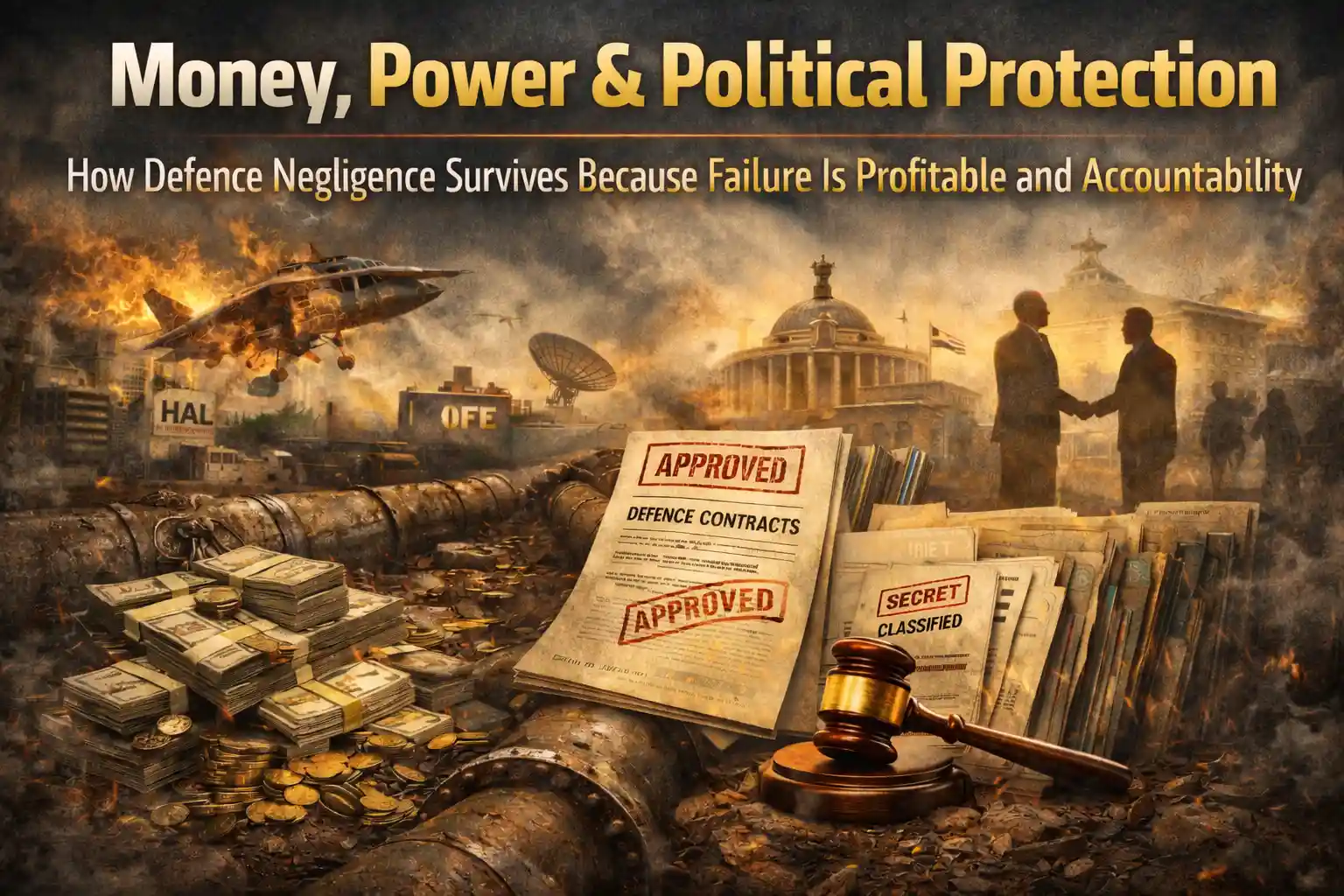
India’s defence system combines some of the world’s highest peacetime defence allocations. Recurring audit findings on delays, cost overruns, quality lapses, and incomplete offset obligations in key procurement and production programmes. The documented costs of crashes, defective ammunition, and failed offsets are dispersed across public budgets. Armed forces operations and soldier families, while institutional accountability for preventable failures remains weak and fragmented. pib+6
This article synthesises:
- Official defence budget allocations from the Ministry of Defence and the Government of India. pib+3
- CAG audits on Defence Public Sector Undertakings, emergency procurement, and defence offsets. cag+3
- Government and media summaries of DPSU dominance in defence production. pib
ICPR’s analysis uses these sources to map how large money flows, PSU dominance, and procurement opacity. Limited enforcement of audit findings together creates a political economy in which the financial and human costs of failure are high. But institutional consequences for those overseeing procurement and production remain comparatively low. thewire+3
1. Follow the Money: Defence Spending and Weak Cost-of-Failure Accounting
India is consistently among the world’s largest defence spenders by absolute outlay, with allocations crossing ₹6.21 lakh crore in FY 2024–25. In the Regular Union Budget 2024–25, the Ministry of Defence was allocated ₹6,21,940.85 crore. The highest among all ministries-with capital outlay for defence services pegged at ₹1.72 lakh crore. ddnews+4
Budget documents and official press releases present detailed breakdowns of revenue, capital outlay, and pensions. But they do not separately account for total financial losses due to aircraft crashes, destroyed platforms, ammunition failures, or related operational disruptions. CAG audits and parliamentary material occasionally quantify specific losses from rejected ammunition, foreclosed contracts, or time‑barred claims. There is no consolidated “cost of failure” line item in defence budgeting practice. indiabudget+5
ICPR analytical note: ICPR’s defence budget reviews argue that without explicit aggregation of losses arising from crashes, defective production, and delayed projects. Policymakers and the public cannot easily link budget size with safety and reliability outcomes. icprindia
2. Defence PSUs: Dominant Producers, Repeated Audit Flags
Defence Public Sector Undertakings (DPSUs) continue to dominate India’s defence production landscape. The Ministry of Defence’s year‑end review for 2025 notes that DPSUs and other public sector entities accounted for approximately 77%. The total defence production value, with the private sector contributing about 23%. DPSUs span aerospace platforms, ammunition and explosives, armoured vehicles, naval shipbuilding, and associated equipment. pib
CAG’s 2025 audit report on Defence Public Sector Undertakings identifies multiple systemic issues. Including delays in the receipt of input materials and inspection. This adversely affected production schedules, as well as serious quality and feedback‑loop failures in ammunition production. The same report highlights that rejected lots of propellant worth ₹4.12 crore were disposed of by burning without adequate root‑cause analysis, resulting in a “loss of opportunity to ascertain the exact reasons for rejection” and reducing the risk of future failures. cag
2.1 Why Monopoly‑Like Dominance Matters (ICPR Analysis)
In competitive supplier markets, repeated quality failures and delays typically expose vendors to loss of future orders. That includes liquidated damages and reputational harm. Whereas DPSUs, by design, remain central to India’s supply ecosystem regardless of audit findings. CAG can flag losses and systemic deficiencies, but its reports do not automatically terminate contracts or force leadership changes. The corrective action rests with the executive and service headquarters. cag+3
ICPR’s institutional analysis argues that this structure cushions DPSUs from market‑style discipline. While leaving the armed forces to absorb front‑line operational risk when quality or timeliness problems occur. thewire+2
3. Political and Institutional Protection: Limited Consequence for Systemic Failure
3.1 The “Strategic Asset” Logic
Official policy places indigenous defence production and DPSUs at the centre of “Atmanirbhar Bharat” and national security strategy. Framing them as strategic assets is crucial for self‑reliance and technology development. This strategic framing makes large‑scale punitive action-such as dismantling major PSUs-politically and operationally costly, particularly when they are primary or sole suppliers for critical categories. ddnews+1
CAG’s findings on quality lapses, rejected ammunition lots, and delayed or foreclosed contracts. These are officially acknowledged, yet the follow‑up often involves regularisation of losses, procedural instructions, and internal reviews. Rather than headline‑level structural penalties. For instance, in the ammunition case noted above, the Ministry later informed CAG that “the loss for all three rejected lots has been regularised as approved by the competent authority,” without publicly available evidence of broader systemic accountability. cag+1
3.2 Cross‑Party Continuity (ICPR Analysis)
Over nearly two decades-from the mid‑2000s to mid‑2020s-multiple governments have overseen the same core institutional constellation. Large DPSUs, offset‑based procurement, and centralised ministerial control. Parliamentary debates and committee reports show criticism of individual deals, delays, or offset outcomes.
This pattern is a form of bipartisan continuity: governments change, but the basic protections around defence institutions and procurement structures remain, with oversight focusing on episodic controversies rather than systemic redesign. prsindia+2
4. Procurement Opacity and Defence Offsets: Documented Gaps
4.1 Secrecy and Limited Timely Disclosure
Defence procurement operates under a distinct legal and policy regime, with manuals such as the Defence Procurement Manual (DPM) 2025 setting out procedures and emphasising transparency and accountability “subject to security considerations.” However, defence contracts are often shielded from full public disclosure on grounds of national security. Certain categories are excluded from the Right to Information Act, and technical details tabled in Parliament may be limited. mod+2
CAG has itself noted that secrecy restricts the scope and timing of audits in sensitive defence areas, which can delay the detection and public reporting of procurement and production deficiencies. saiindia+2
4.2 Offsets: Ambitious Design, Limited Realisation
India’s defence offsets policy, introduced in 2005, sought to leverage large defence imports to build domestic capability and attract technology and investment. CAG’s 2020 performance audit of defence offsets (and media summaries of that report) reveal significant gaps between policy objectives and implementation: between 2007 and 2018, 46 offset contracts worth ₹66,427 crore were signed, of which offsets worth ₹19,223 crore should have been discharged by 2018, but only ₹11,396 crore (about 59%) had been claimed as discharged, and only a fraction of these were finally accepted as compliant. indianexpress+1
The same audit notes that the offsets policy delivered “negligible” foreign direct investment and that DRDO had not acquired any high technology through offsets in the examined period. Despite these findings, there is little public evidence of large, headline‑making penalties or contract terminations purely on offset‑performance grounds. peoplesdemocracy+1
ICPR uses these offset outcomes as a case study in how complex financial obligations in defence procurement can underperform for years without triggering swift and visible corrective action. indianexpress+2
5. Bureaucratic Diffusion of Responsibility (ICPR Analysis)
Defence procurement decisions typically involve multiple layers: requirement formulation by services, technical evaluations, commercial negotiations, and approval by ministry committees. The final sanction by the competent authority. Rotational postings, collective decision‑making, and committee structures distribute signatures across many actors. This is intended to reduce individual discretion and combat corruption, but also complicates backward tracing of responsibility when outcomes are poor. mod
CAG reports on emergency procurement and indigenisation highlight instances where deviations from procedure were “regularised” ex post facto. Where delays at different stages of the process contributed to capability gaps, without the reports naming individual officials for sanction in public. ICPR’s governance work argues that this architecture can lead to a situation where failures are institutionally acknowledged but rarely attach to identifiable decision‑makers in a way that produces strong deterrence. thewire+2
6. Narratives of Nationalism and the Scrutiny Gap (ICPR Analysis)
Government documents and public statements frequently frame indigenous defence production and higher defence budgets as symbols of national pride. Sovereignty and technological advancement, especially in the context of “Make in India” and “Atmanirbhar Bharat.” In the public arena, criticism of flagship indigenous programmes or defence institutions can be politically sensitive. Some narratives equate sharp scrutiny with undermining national security goals. economictimes.indiatimes+2
ICPR’s normative position is that robust democratic oversight and investigative scrutiny are consistent with, and essential to, genuine national security. That equating criticism of institutional performance with a lack of patriotism reduces incentives for whistleblowing and independent analysis. icprindia
- ICPR analysis on nationalism and governance: When Warnings Were Ignored: Indian Defence Classified Reports
7. Who Pays the Price? (Documented Effects and ICPR Framing)
7.1 Material and Human Costs
When equipment fails or procurement underperforms, immediate costs are borne by the armed forces and their personnel. CAG’s DPSU audit shows that defective ammunition and disputed proof results led not only to destroyed lots. Inventory blockages are worth several crore rupees, but also lead to the delayed availability of critical munitions. CAG’s emergency procurement audit indicates that in 72% of examined Army emergency procurement contracts. Items were not delivered within the stipulated timelines, undermining the stated objective of swiftly addressing capability gaps. cag+1
In the case of air crashes, parliamentary and media reports document fatalities among aircrew and passengers. While attributing more than half of the 34 Air Force accidents between 2017 and 2022 to “human error,” without placing a monetary value on lost platforms and downstream operational impact in budget documents. ICPR’s interpretation is that the combination of unpriced material loss and limited public visibility of investigation findings shifts much of the burden onto soldiers, families, and frontline units. theprint+5
7.2 Institutional Impact
ICPR’s review suggests that persistent questions about equipment reliability and procurement outcomes can affect morale and trust within the services. Even when such concerns are rarely voiced in official statements. Operational commanders may adopt more conservative usage profiles for certain platforms or munitions based on experience and informal risk assessments, which have implications for readiness and deterrence. rmlnlulawreview+2
8. Why Structural Reform Is Hard (ICPR Analysis Based on Documented Patterns)
Reforms that would significantly alter incentives-such as stringent supplier liability and fully independent investigation authorities. The automatic contract penalties for repeated quality failures would directly affect established procurement practices. PSU interests, labour politics, and institutional reputations. CAG can recommend improvements, and procurement manuals can tighten procedures. But actual enforcement depends on political and bureaucratic will to confront short‑term disruption in exchange for long‑term safety and efficiency. cag+6
ICPR argues that, given the size of financial flows and the concentration of production in a limited set of entities, there are strong incentives across the system to manage reputational risk and keep failures administratively contained, rather than to embrace highly disruptive structural changes. pib+2
9. International Benchmarks: Practices India Has Only Partially Emulated
In several advanced militaries and civil‑military systems, independent accident investigation boards publish redacted reports, issue safety recommendations binding on operators, and link severe quality failures to contractual or legal consequences. ICAO Annex 13 and guidance on safety occurrence investigations emphasise independence, transparency, and the primacy of learning over blame, along with public availability of final reports in most cases. applications.icao+4
India has taken steps towards international best practice in civil aviation through the Aircraft Accident Investigation Bureau (AAIB), but military accident investigations remain largely internal and classified, and enforcement of supplier liability in defence, while possible under contract law, has not yet produced a publicly visible track record comparable to some of these models. ICPR’s comparative defence governance study highlights this gap between global norms and India’s current approach to defence transparency and accountability. forumias+3
10. Breaking the Protection Loop (ICPR Reform Proposals)
Drawing on documented deficiencies in audits, offsets, and procurement performance, as well as international best practice, ICPR advocates a reform package focused on five pillars: skybrary+5
- Independent Defence Accident Investigation Authority
- Statutory body with functional independence from services and suppliers, modelled on Annex 13 principles, mandated to investigate serious defence accidents and publish redacted reports. skybrary+2
- Mandatory Publication of Redacted Reports
- Legal requirement to release redacted findings and safety recommendations for defence accidents after completion of investigations, subject to narrowly defined security exceptions. applications.icao+2
- Contractual Liability and Penalty Framework
- Explicit, enforceable clauses linking critical quality failures to financial penalties, blacklisting or mandatory corrective programmes, building on evidence from CAG reports on ammunition, offsets and emergency procurement. peoplesdemocracy+3
- Strengthened Parliamentary Enforcement Tools
- Formal tracking and public reporting of implementation status of Standing Committee and PAC recommendations in defence, with time‑bound action plans and escalation mechanisms. eparlib.sansad+3
- Whistleblower Protection in Defence Ecosystems
- Robust mechanisms, aligned with global safety‑culture guidance, to protect and incentivise reporting by engineers, technicians, aircrew, and auditors on safety‑critical risks. spsairbuz+2
ICPR’s full defence accountability reform blueprint integrates these pillars into a proposed legislative and institutional design for India. icprindia
- ICPR Defence Reports: The Hidden Crisis of Sub-Standard Defence Production in India
Conclusion
Official defence budget data, CAG audits, offset performance assessments, and production statistics together demonstrate a system where very large financial commitments coexist with persistent weaknesses in procurement performance, quality assurance, and transparent investigation. ICPR’s analysis is that this configuration creates a political economy in which the costs of failure-financial and human, are widely socialised, while strong institutional accountability for avoidable failures is comparatively rare. pib+6
Until India systematically aligns its defence investigation, procurement enforcement, and parliamentary oversight mechanisms with the standards it already accepts in civil aviation and with emerging global norms, the imbalance between money, power, and protection on one side and safety and accountability on the other is likely to persist. skybrary+5
Leave a Reply