
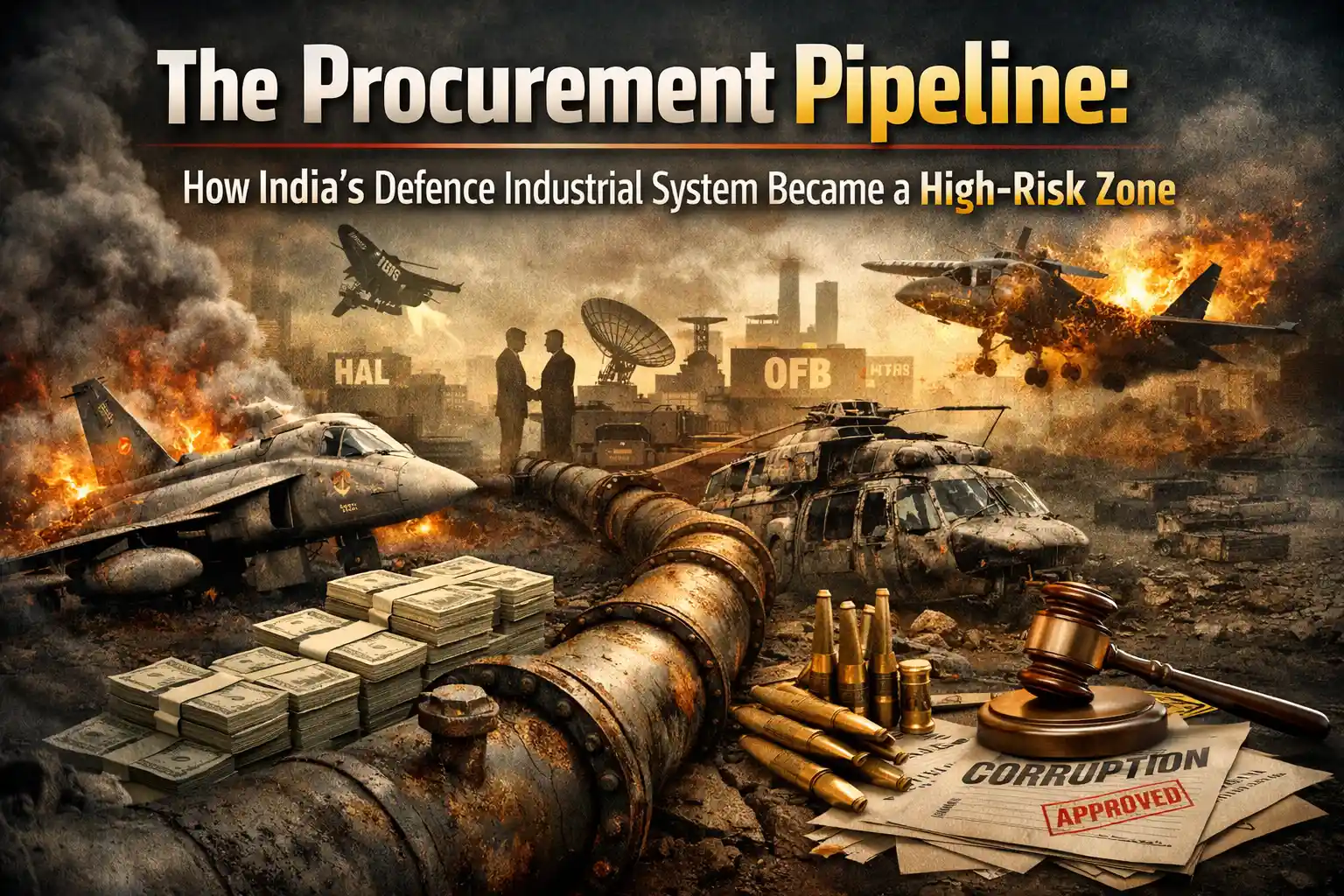
India has been pouring ever-greater resources into defence modernisation, yet its procurement systems remain deeply vulnerable to inefficiency and corruption. This report unpacks how key structural features of the procurement pipeline-particularly the offset mechanism, vendor monopolies, and weak oversight-have bred systemic risk. The result: sub-standard equipment, delayed deliveries, cost‐overruns, and a growing mismatch between ambition and deliverables. Subsequent parts will trace how this structural failure filters through to the frontline: faulty gear, accident triggers, and human casualties.
Key findings include:
- Between 2007 and 2018, India signed 46 offset contracts worth ₹66,427 crore, but by the time of the audit, it had fulfilled only ₹11,396 cror-about 59% of the required ₹19,223 crore offset discharge. NewsClick
- India’s procurement transparency score places it in the “high risk of corruption” category in the Government Defence Anti-Corruption Index; procurement and personnel are among the weakest areas. government.defenceindex.org, The Economic Times
- The decision under the Defence Acquisition Procedure (DAP) 2020 to waive offsets for Government-to-Government procurements removed a key lever intended to tie vendor payment to investment in the Indian defence industry. The Economic Times
This first piece sets out the contours of the procurement and offset architecture, identifies fault‐lines, and highlights how structural vulnerabilities became embedded. In doing so, it lays the groundwork for later series that will link these architectural failures to equipment breakdowns, crashes, and frontline casualties.
Section 1: The Procurement Architecture – A Complex Landscape
High strategic stakes, large budgets, and significant secrecy define India’s defence acquisition system. According to the Comptroller & Auditor General of India (CAG), the audit of India’s defence services faces “the secretive nature of the functioning of defence” and yet must “fulfil its constitutional obligation through probe and scrutiny.” Comptroller and Auditor General of India
Procurement of major capital equipment typically moves under successive versions of the Defence Procurement Procedure (DPP), incorporating tenders, trials, vendor selection, offsets, contract management, delivery, and post-delivery sustainment.
Key features:
- Substantial funds allocated for platform acquisition (aircraft, helicopters, armoured vehicles, naval vessels).
- Mandated offsets requiring foreign OEMs to invest part of the contract value into the Indian industry or technology transfer.
- PSUs (public sector undertakings) and domestic suppliers play dominant roles in execution, often enjoying limited competition.
- Audit and oversight functions via CAG, internal MoD mechanisms, parliamentary committees—but with constrained access and delays.
This architecture aims to balance strategic independence (“Make in India”), industrial growth, technological upgrades, and operational readiness. Yet multiple audit findings show that it fails to realise many of these aims.
Section 2: The Offset Mechanism – Promise and Performance
Offsets ensure that when India procures foreign military equipment, it reinvests a portion of the contract’s value into Indian industry through purchases, FDI, or technology transfer.
What the numbers show:
- Between 2007 and 2018, 46 offset contracts worth ₹66,427 crore were signed. NewsClick
- Of the discharge obligation of ₹19,223 crore, only ₹11,396 crore had been discharged (≈59 %) by audit time. NewsClick
- Audit found instances where “ready-built equipment without any value addition through Indian Offset Partners (IOPs)” were accepted as offsets—contravening intent. In one sample of 16 contracts worth ₹18,444.56 crore, five contracts worth ₹3,410.49 crore accepted such equipment. Comptroller and Auditor General of India
Where the gaps lie:
- Weak definitions: Indian Offset Partner, value-addition, and technology absorption are often loosely defined and open to interpretation. Comptroller and Auditor General of India
- Monitoring: Post-contract discharge monitoring is weak; vendors often only meet formal criteria, not substantive technology transfer or capability build-up.
- Incentive misalignment: The vendor’s cost of meeting offsets is often baked into the contract price, reducing competitive pressure.
- Policy watering: In DAP 2020, offsets were waived for Government-to-Government (G2G) deals (single-vendor) to expedite procurement, but this eliminates the investor tie-back. The Economic Times
Why this matters: Offsets are a key linkage between procurement and industrial capacity, but when they fail, the Indian defence-industrial base remains underdeveloped, and foreign dependence persists—even as local manufacturing claims increase.
Section 3: Monopoly Dynamics & Vendor Concentration
In many segments of India’s defence acquisition ecosystem, a small set of PSUs and select vendors dominate. The result: limited competition, weak price discipline, and reduced incentive to maintain rigorous quality and schedule.
Structural attributes:
- PSUs such as Hindustan Aeronautics Limited (HAL) and the Ordnance Factory Board (OFB) have enjoyed de facto monopolies or very restricted supplier ecosystems.
- Competitive sourcing is limited when tenders are tailored for specific vendors or when vendor pools are narrow.
- Procurement secrecy and single-vendor situations reduce market scrutiny and transparency.
Audit critique & external assessment:
- Transparency International found that India’s defence procurement remains among the “very high risk” category for corruption. The Economic Times
- The narrow vendor base reduces the ability of oversight agencies and market forces to impose corrective pressure.
Implications:
- Cost escalations: Without competition, vendors can build in a margin for delays or quality shortcomings.
- Quality complacency: Minimal risk of losing out means less incentive for stringent quality assurance.
- Delivery slippages: Monopolistic vendors face less reputational risk from delayed deliveries or cost overruns.
Section 4: Transparency, Audit & Accountability – Weak Links
Procurement needs real-time oversight, quality audit, independent investigations, and meaningful sanctions. Yet multiple reports show significant gaps.
Audit findings:
- The CAG finds that defence audit offices face special challenges: “the secretive nature of the functioning of defence and yet fulfil its constitutional obligation through probe and scrutiny.” Comptroller and Auditor General of India
- A 2024 CAG Report (No. 11 of 2024) flagged wasteful expenditure in non-capital items—though not exclusively hardware procurement—but illustrated weak accountability in defence expenditure as a whole. Comptroller and Auditor General of India
- A recent compliance audit observed under-realisation of offset benefits and excess provisioning of spares in a tanker deal: e.g., a ₹30.44 crore excess in spare provisioning and under-realisation of offset benefits for a ₹936 crore contract. Comptroller and Auditor General of India
Accountability ecosystem issues:
- Investigations into major procurement scandals (e.g., some Rafale-related concerns; see CAG probe) remain protracted. Business Standard
- Parliamentary committees often work post-fact, lacking real-time intervention.
- Agencies designate many contracts as classified or under “national security,” which reduces public disclosure and limits scrutiny.
Why this matters: Without robust accountability, procurement deviations (inflated costs, delayed delivery, quality shortcuts) are effectively costless to perpetrators. This emboldens further deviations and systemic rot.
Section 5: Consequences – Strategic, Industrial and Operational Fallout
The structural and procedural vulnerabilities described above are not just administrative – they translate into real strategic risk, industrial stagnation, and operational failure.
Strategic risk:
- Delays in the delivery of critical platforms reduce readiness; for example, missing induction timelines compromise force deployment.
- Poor quality or low-capability equipment undermines deterrence credibility.
- Industrial shortfall means India continues to depend on foreign OEMs for key systems.
Industrial stagnation:
- Offsets not realised → Domestic industry remains weak, technology absorption limited.
- Vendor monopolies discourage emergent domestic players.
- Procurement structure tilted toward incumbents suppresses innovation and agility.
Operational failure:
While later parts of this series will probe specific failures, we can already draw a preliminary connection: poor procurement processes increase the risk of sub‑standard equipment, accelerated maintenance costs, unexpected failures, and ultimately higher casualties.
Section 6: Case Study – Offsets in Aviation Procurement
To illustrate the interplay of procurement, offset, and domestic industry shortfall, consider aviation procurement scenarios.
- A CAG audit revealed that in 16 offset contracts (2007-11) worth ₹18,444.56 crore, five contracts worth ₹3,410.49 crore accepted “ready-built equipment without any value addition through Indian Offset Partners (IOPs)”. Comptroller and Auditor General of India
- The implementation of offsets in aviation and aerospace has repeatedly been critiqued for failing to produce meaningful domestic capability, despite large foreign purchases.
This tells us that even when a large investment occurs, the domestic industrial benefit (technology absorption, capability build, manufacturing footprint) often falls short—undermining the stated “Make in India” objective.
Section 7: Drivers & Enablers of the Structural Weakness
Why has procurement become structurally weak? Among the primary drivers:
- Secrecy and urgency: Defence procurement is often fast-tracked in the name of national security. This urgency is used to justify the waiver of normal transparency and competitive practices.
- Single-vendor / G2G deals: Where only one vendor qualifies (or is chosen), the competitive tension disappears, reducing value‐for‐money pressure and enabling cost or quality slippage.
- Weak sanctions: Even when audits highlight failures, follow-through is slow and penalties mild, reducing deterrence.
- PSU monopolies and political economy: Large state firms enjoy patronage, restricted competition, and limited market discipline, weakening accountability.
- Offset dilution: As offsets falter, the domestic industrial link weakens, reducing incentive for quality and capability churn.
- Fragmented oversight: Multiple agencies (MoD, CAG, Parliament, Armed Services) with overlapping or unclear mandates—delays and gaps are inevitable.
Section 8: Moving Forward – Reform Imperatives
A number of reforms would strengthen the procurement pipeline:
- Mandate full transparency for procurement above a threshold: publishing key contract terms, delivery milestones, and penalty clauses.
- Enforce independent crash/investigation boards (relevant in later parts) whenever equipment fails, with public reporting.
- Strengthen offset monitoring: not just formal discharge, but actual technology transfer, measurable capability outcomes, and independent verification.
- Introduce competitive vendor ecosystems: Reduce PSU monopolies, open regulated private sector participation, and encourage global players via fair bidding.
- Real-time oversight dashboards: Track major procurements, publish schedule slippages, penalties triggered, and quality failures.
- Legislatively strengthen sanctioning: Timely and visible penal action against vendors, officials, and agencies for procurement failure or corruption.
- Institutionalise lifecycle cost disciplines: Procurement shouldn’t stop at delivery; sustainment, upgrades, and field reliability must be embedded up front.
Conclusion
The procurement pipeline in India’s defence ecosystem is a foundational vulnerability. The systems designed to deliver high-value assets and build domestic industrial capability instead harbour risk: cost escalations, industrial shortfall, quality compromises, and strategic vulnerability. By treating procurement as simply “buying equipment” rather than as a system encompassing vendor selection, offsets, industrial capability build, delivery, sustainment, and accountability, India has allowed structural failure to set in.
This first report exposes the structural rot forged not by singular scandals but by architectural weakness. The human cost, in terms of equipment failure, frontline casualties, and loss of readiness, remains to be fully documented. In the next series, we will move from process to product: examining how sub-standard gear, faulty components, and mechanical failures on the ground link back to this procurement architecture.
Leave a Reply